Degree? Check! (Oh well, almost.) Resume? Check! LinkedIn up-to-date? Check! Active Facebook profile? Check! Job? Uhm, working on it…
As we’re almost graduating, we noticed that the online headhunting season has begun. We’re no longer just invited to job fairs and recruiting events from companies looking for young potentials, they’re also targeting us through social media. They do not only focus on LinkedIn, recruiting through Facebook has become more and more popular recently. The recruiters are aiming from all corners and on our Newsfeed it becomes clear that half of our friends are signing job contracts and the other half can still spend all their evenings carefree at the bar.
More in particular, there are three emerging trends when it comes to recruiting on Facebook. Will Staney discusses in his article the use of Facebook live videos, the social network as a search engine and paid social advertising as means to support the HR department.
First of all, the newest feature of Facebook: Live videos, a real-time broadcast to an online audience. Viewers can comment directly on these videos, which allows for interaction with the broadcaster. The topics range from playing kittens (with over 22.000 viewers!) to, of course, recruiting. Companies tend to use this feature as a strategy to offer an insight in their corporate environment and to emit employee testimonials to a broad audience.
When we check our own Facebook, we can find companies such as Doctors Without Borders and the Canadian Space Agency having a live Q&A with the interested Facebook audience. They answer questions like what it's like to work for their company, which positions are vacant and how you can apply. You could compare this concept to an online chat, but in the end it has so much more to offer. In our opinion, videos, compared to chats, offer a more natural and personal response since the body language of the broadcaster is also visible. Further, you are not the only one asking questions, so other viewers might ask questions that you haven’t thought of yet or if you’re too shy to ask something, you can just lurk and get to know the company anyway.
 |
| Live recruiting Q&A video Doctors Without Borders |
 |
| Live recruiting video Canadian Space Agency |
Next, heaps of information on companies can also be found by using the social network as a search engine. Not only live videos can offer a sneak peak into the cultural environment of the company, but regular Facebook posts can also fulfil the same function. The article mentions that reviews are becoming increasingly popular, especially on social platforms such as Glassdoor. However, we assume that in the future this trend can easily be transferred to Facebook as well. For example, product reviews are already common on the platform. On the one hand this user-generated content can serve as a reference for job seekers, so they can make sure the company matches their interests. On the other hand, companies can provide a direct link to their website, where the job seekers can find more information as well. When we looked on Facebook for companies such as L'Oréal and J.P. Morgan Chase,we noticed that they both have posts intended to convey the company culture. J.P. Morgan Chase shows off with employee events such as marching for gay rights and L’Oréal lets interns post about their experience on the company's Facebook wall. We believe that this is a good way to show the human face of the company, making it more relatable for followers and more attractive than a regular company website. After all, life isn’t only about work.
 |
| L'Oréal intern post |
 |
| J.P. Morgan Chase employee march |
The final trend discussed is paid social advertising, meaning that companies pay for example Facebook to make one of their recruiting ads appear on the Newsfeed of a certain targeted audience. In emerging markets, Staney spotted a 200% increase in applications with this strategy. As we’ve seen for ourselves so far, this is usually disguised as native advertising. It seems reasonable to assume that sponsored ads like ‘PacaJob’ are based on our current location and others like ‘AB InBev’s Fast Track Apprenticeship’ are based on past search queries, since Valerie is actually applying for this job. To us, it is very interesting to get some information through these channels since new opportunities show up and jobs that you haven’t thought of before can come to your attention very easily. However, if Valerie doesn’t get the job, these ads better don't appear on her Newsfeed anymore in order to avoid possible emotional breakdowns. You know, eating all that chocolate won't be good for her.
 |
| PacaJob suggested post - native advertising |
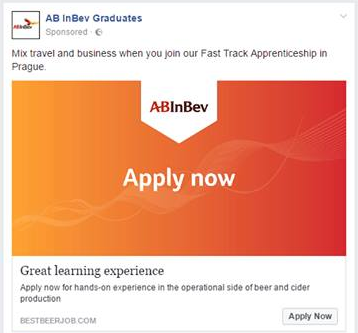 |
| AB InBev sponsored ad - native advertising |
Since the current generation spends a lot of time on social networks, social recruiting facilitates their first job search and might offer them new insights of what their opportunities on the job market are. Furthermore it has become a requirement for employees to be able to deal with social media. So, no better way than recruiting them directly through these platforms. In addition, even if companies don’t intend to recruit them immediately, they can still convey the company’s human side and its values, which can allow people to identify with the company. Customers might even find your company more appealing than your competitors' through the messages you communicate on social media and this can induce customer loyalty.
As active job seekers, we welcome this evolution with open arms. We’re happy to let the headhunters take a shot at us, so we can find a job we love.
May the odds be ever in our favor!
Jana De Lobel & Valerie Eeckhout
Source article: https://www.proactivetalent.io/blog/top-3-social-recruiting-trends-2016
Source images: screenshots Facebook
Doctors Without Borders - https://www.facebook.com/msf.english/videos/10153744877272385/?__mref=message_bubble
Canadian Space Agency - https://www.facebook.com/CanadianSpaceAgency/videos/1130446060310923/?__mref=message_bubble
J.P. Morgan Chase - https://www.facebook.com/jpmorganchase/?fref=ts
L'Oréal Talent - https://www.facebook.com/LorealCareersFrance/?brand_redir=101260029596
PacaJob - Screenshot Facebook Jana De Lobel
AB InBev - Screenshot Facebook Valerie Eeckhout

 The reason why the companies try to achieve ads that don't look like ads is that the power of the ad decreases when consumers discover that it is nothing else than an ad. To make advertising more effective and to keep the power of the ad, companies use some methods to create ads that look like editorial content. Rodnitzky describes some of these methods as native advertising, sponsored editorial content, influencer marketing, adwords and social media advertising in his article. What these methods have in common is that they in different ways fool the potential customer and the way they are thinking about the ad. When an ad looks like native content, some customers will perceive the ad as real content and not paid advertising. Influencer marketing, when a person gets paid to promote products on various social media, becomes more common. Influencers are perceived as more authentic than celebrities and therefore can customers more easily relate to influencers than celebrities. This personal connection makes the transference in this case even stronger, according to Rodnitzky. On social media channels, such as Facebook and Twitter, it can be difficult to distinguish between ads and content for the user, even if they have symbols that separate ads from content, they are difficult to distinguish.
